
INDIA TOUR OF NEW ZEALAND 2026 · 5TH ODI · PRE-MATCH ANALYSIS · UPDATED 14 NOVEMBER 2026
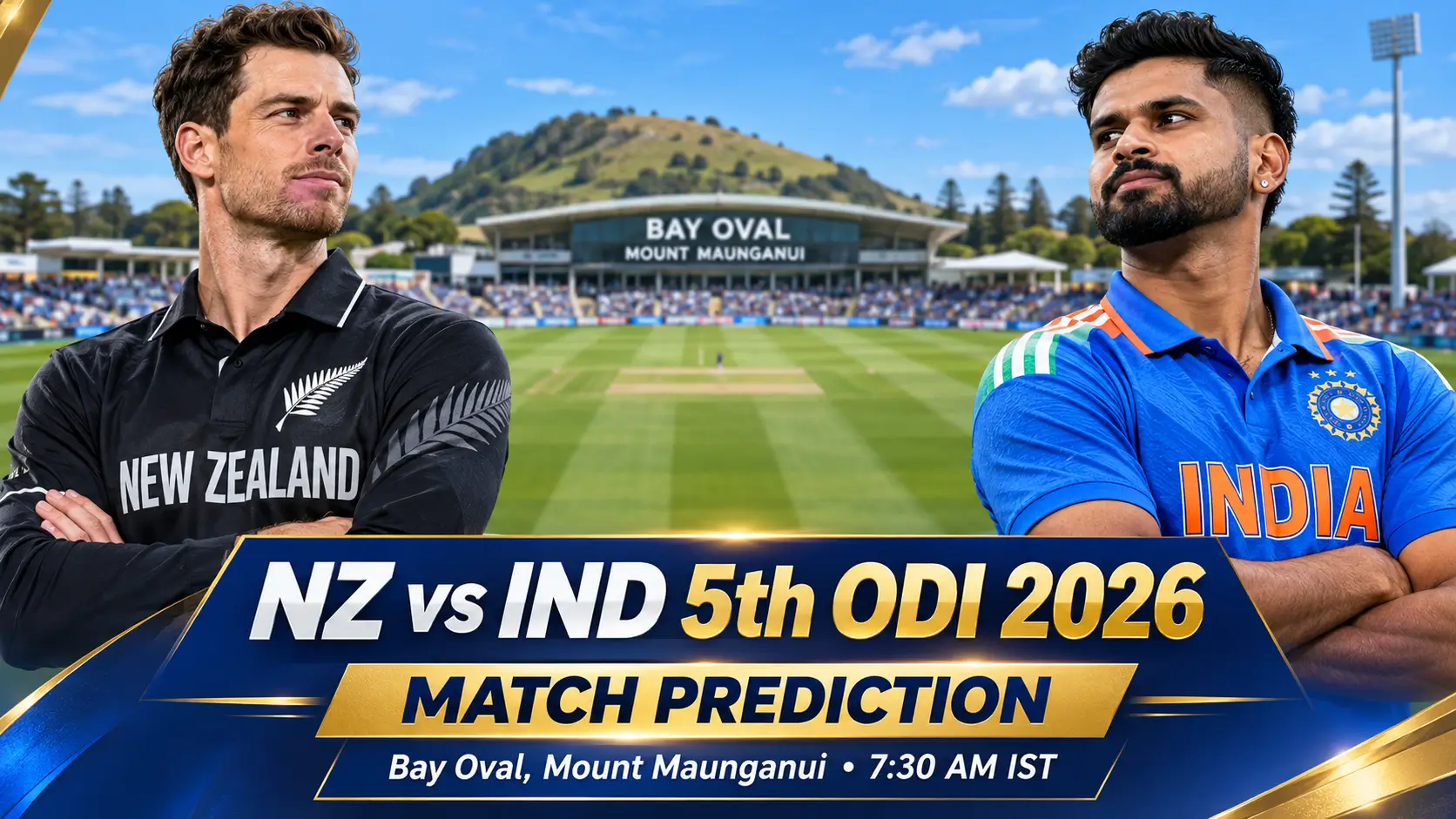
The NZ vs IND 5th ODI 2026 Match Prediction comes down to a compelling question: will India recover from a 244-run defeat, or can New Zealand repeat their commanding performance at Bay Oval? The final match of the five-ODI series is scheduled for Sunday, 15 November, at 7:30 AM IST in Mount Maunganui. India lead 2–1 after four matches.
Quick prediction: New Zealand have a slight form-and-venue advantage after scoring 333 and dismissing India for 89 at Bay Oval on Friday. However, Matt Henry and Kyle Jamieson are unavailable for the decider, changing the hosts’ bowling attack. India can still win if their top order survives the new ball and builds partnerships. This is an assessment, not a certain result.
The fourth ODI generated two very different batting stories. Will Young made 125 from 108 balls to help New Zealand reach 333. Matt Henry then took 6/27, including three wickets in his opening over, and India were dismissed in 26.4 overs. That result does not erase India’s victories in the first two matches, but it raises urgent questions about technique, team balance and the way both teams will approach the new ball.
NZ vs IND 5th ODI 2026: Match Details and Series Situation
The fifth ODI closes the limited-overs portion of India’s tour of New Zealand. It is a scheduled 50-over international, not a T20 match, and takes place at the same venue as the fourth ODI. That short turnaround matters because there is limited opportunity to completely change preparation or acclimatise to a different ground.
| Match information | Confirmed details |
|---|---|
| Fixture | New Zealand vs India, 5th ODI |
| Series | India tour of New Zealand, 2026 |
| Date | Sunday, 15 November 2026 |
| Start | 7:30 AM IST / 3:00 PM NZDT |
| Venue | Bay Oval, Mount Maunganui, New Zealand |
| Series before match | India lead 2–1; third ODI abandoned |
| India captain | Shreyas Iyer |
| New Zealand captain | Mitchell Santner |
| Toss and final XIs | Not announced as of this preview |
India’s first two wins came in Auckland and Wellington. Rain prevented the third match in Hamilton from producing a result, before New Zealand hit back on 13 November. India therefore cannot lose the five-match series outright. New Zealand, on the other hand, can level it at 2–2 by winning Sunday’s fixture, making the contest meaningful even without a conventional series-deciding winner-takes-all scenario.
Bay Oval Pitch Report: Batting or Bowling Friendly?
Bay Oval is not a venue that can be described with one permanent label. The same ground that supported Young’s 125 and a New Zealand total of 333 also offered Matt Henry enough movement and control to demolish India’s top order. The difference was partly a matter of execution, lengths and pressure rather than proof that conditions were identical for both innings.
For the fifth ODI, early assistance for accurate seam bowling is a realistic possibility. Batters who drive too early or play away from their bodies may be exposed if the ball moves. Yet the fourth ODI also showed that once a batter settles, the outfield and scoring opportunities can reward positive strokeplay. The strongest teams will distinguish difficult new-ball periods from opportunities later in the innings.
Bay Oval ODI records and average scores
Venue databases do not agree on a single average because their match filters and date ranges differ. One published venue dataset lists 13 men’s ODIs with a first-innings average of 268, whereas a separate recent-match dataset offers a lower figure for its selected sample. These are not interchangeable statistics. Any headline claiming one universal average without describing the underlying sample is potentially misleading.
| Venue measure | Published figure | Interpretation |
|---|---|---|
| Men’s ODI sample | 13 matches | CricketViz venue dataset |
| Average first-innings score | 268 | From the same dataset |
| Chasing wins | 54% of matches with a result | Small sample; not a prediction |
| Previous match first innings | New Zealand 333 all out | 13 November 2026 |
| Previous match second innings | India 89 all out | 13 November 2026 |
These records suggest that a total in the vicinity of 260–280 can be competitive under ordinary conditions, but that should not be treated as a fixed par score. The state of the surface, overhead conditions, quality of the attack and early wickets will determine whether a lower or higher total is truly demanding. Friday’s extreme result is especially important but should not be confused with the historical average.
Fourth ODI team-score comparison
Verified fourth-ODI totals, displayed proportionally; this is not a projection for the fifth ODI.
What the toss could change
Winning the toss does not guarantee an advantage. A captain who expects early lateral movement might prefer to bowl, but the previous match also demonstrated the value of making a strong first-innings total and applying scoreboard pressure. Both captains will need to inspect the surface rather than rely on a rule that Bay Oval always favours chasing.
New Zealand vs India 5th ODI: Predicted Playing XI and Squad Changes
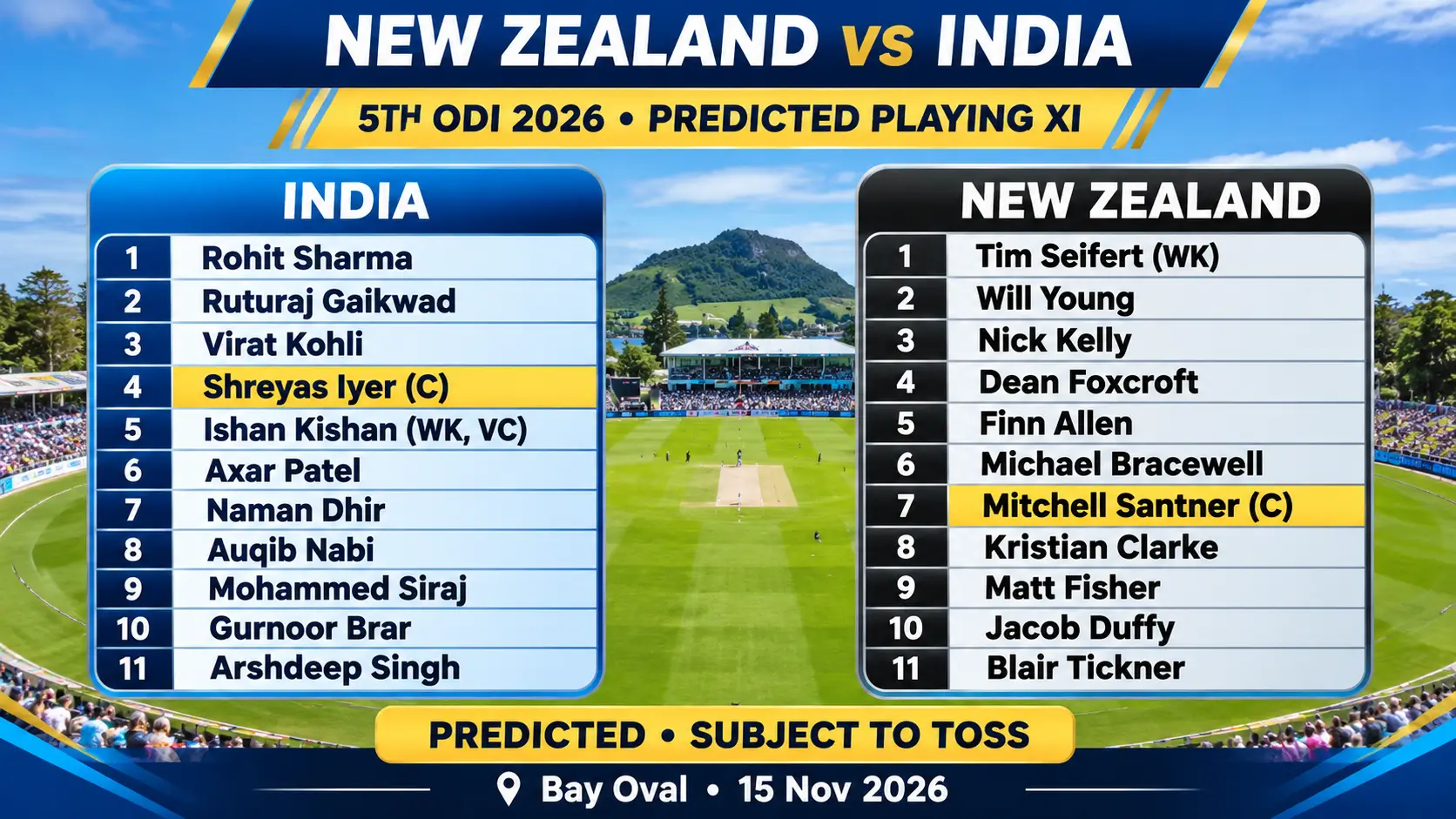
The following combinations are predictions, not confirmed playing XIs. Final selections will be known only at the toss. The main selection issue is New Zealand’s pace attack: Matt Henry and Kyle Jamieson, who combined for seven wickets in the fourth ODI, are unavailable as attention shifts to the Test series. Jacob Duffy returns, while Blair Tickner and Brett Randell provide further pace options.
India predicted playing XI
Possible change: Mohammed Siraj could come in if India adjust their bowling balance. Tilak Varma is another batting option. Neither change is confirmed.
New Zealand predicted playing XI
Selection alternatives include Josh Clarkson and Brett Randell. The final pace combination remains unconfirmed.
India: whether to change a beaten batting order
Rohit Sharma, Virat Kohli and captain Shreyas Iyer all fell for ducks in the fourth ODI. That alone does not establish that any of them should be dropped. Top-order failures are part of the format, and a one-match reaction could create further instability. India may instead work on shot selection, defensive judgement and leaving the ball when it moves outside off stump.
Ruturaj Gaikwad offers another established top-order option, while Ishan Kishan supplied some resistance in the previous match. Axar Patel contributes left-handed batting and disciplined spin; Naman Dhir provides another middle-order option. India’s decision is whether to value batting depth or bring in fresh bowling resources after conceding 333.
The leadership comparison also matters. Shreyas Iyer is captaining this stage of the ODI tour, while Shubman Gill and KL Rahul are with the Test preparations. Ishan Kishan is the available senior wicketkeeping choice in the likely XI. The presence of different personnel from earlier tour fixtures is a reason to check the actual match-day sheet, not reuse an older series lineup.
New Zealand: replacing Henry and Jamieson
Replacing Henry’s new-ball control is a substantial challenge. He began the previous chase by dismissing Rohit, Kohli and Iyer in the opening over, eventually finishing with six wickets. A substitute does not need to copy those extraordinary figures, but New Zealand will need accurate bowling at the start if they are to recreate the pressure that made India’s innings unravel.
Jacob Duffy has experience in the series and offers a logical route back into the side. Matthew Fisher’s three wickets in the fourth ODI strengthen his case to continue, and Kristian Clarke can help balance the bowling resources. Tickner or Randell may provide pace support. Exact roles are conditional on selection and the pitch assessment.
Recent Form: Fourth ODI Collapse, Series Results and Key Players
Recent form is best understood as a sequence rather than one dramatic result. India took the opening two games, the third ODI was abandoned, and New Zealand dominated the fourth. The 2–1 scoreline reflects those four fixtures. Friday’s defeat was severe enough to affect confidence and planning, but it did not take away India’s series advantage.
| ODI | Venue | Outcome | Implication |
|---|---|---|---|
| 1st | Auckland | India won | India began with a lead |
| 2nd | Wellington | India won | India moved 2–0 ahead |
| 3rd | Hamilton | Abandoned due to rain | No result |
| 4th | Bay Oval | New Zealand won by 244 runs | Series 2–1 to India |
| 5th | Bay Oval | Scheduled for 15 November | India can win series 3–1; NZ can draw 2–2 |
Will Young and the New Zealand top order
Young was the defining batter of the fourth ODI, making 125 from 108 balls and converting early opportunities into a match-shaping innings. India missed chances to dismiss him early. His performance underlines two separate risks: New Zealand’s top order can make a demanding total, and India’s fielders cannot afford to give key players extra lives.
Tim Seifert scored 58 and Finn Allen added 41 in the same match. That distribution is important because Young was not New Zealand’s only source of runs. If the openers again survive the first few overs, the hosts can build around the same positive tempo. India need control from both their pacers and their fielding unit, not merely an improved batting reply.
India’s experienced batters and the response required
Rohit, Kohli and Iyer collectively contributed no runs in the fourth ODI, a striking statistic but not a reasonable estimate of their expected contribution on Sunday. The more informative question is how they adjust. Staying compact, respecting movement and reducing early risk could give India the stable opening phase that was missing on Friday.
Ishan Kishan top-scored for India with 27, while Axar Patel and Naman Dhir made 21 apiece. Those small contributions showed that resistance was possible after the collapse, even though the innings was already irreparably damaged. India will want its middle order to arrive with a platform to build upon, not with three or four wickets already lost.
Readers following the wider cricket schedule through the Taj777 .global can use the verified match details here to separate scheduled fixtures and editorial predictions from results that have already been played.
Weather Forecast, Match Timing and Conditions at Mount Maunganui
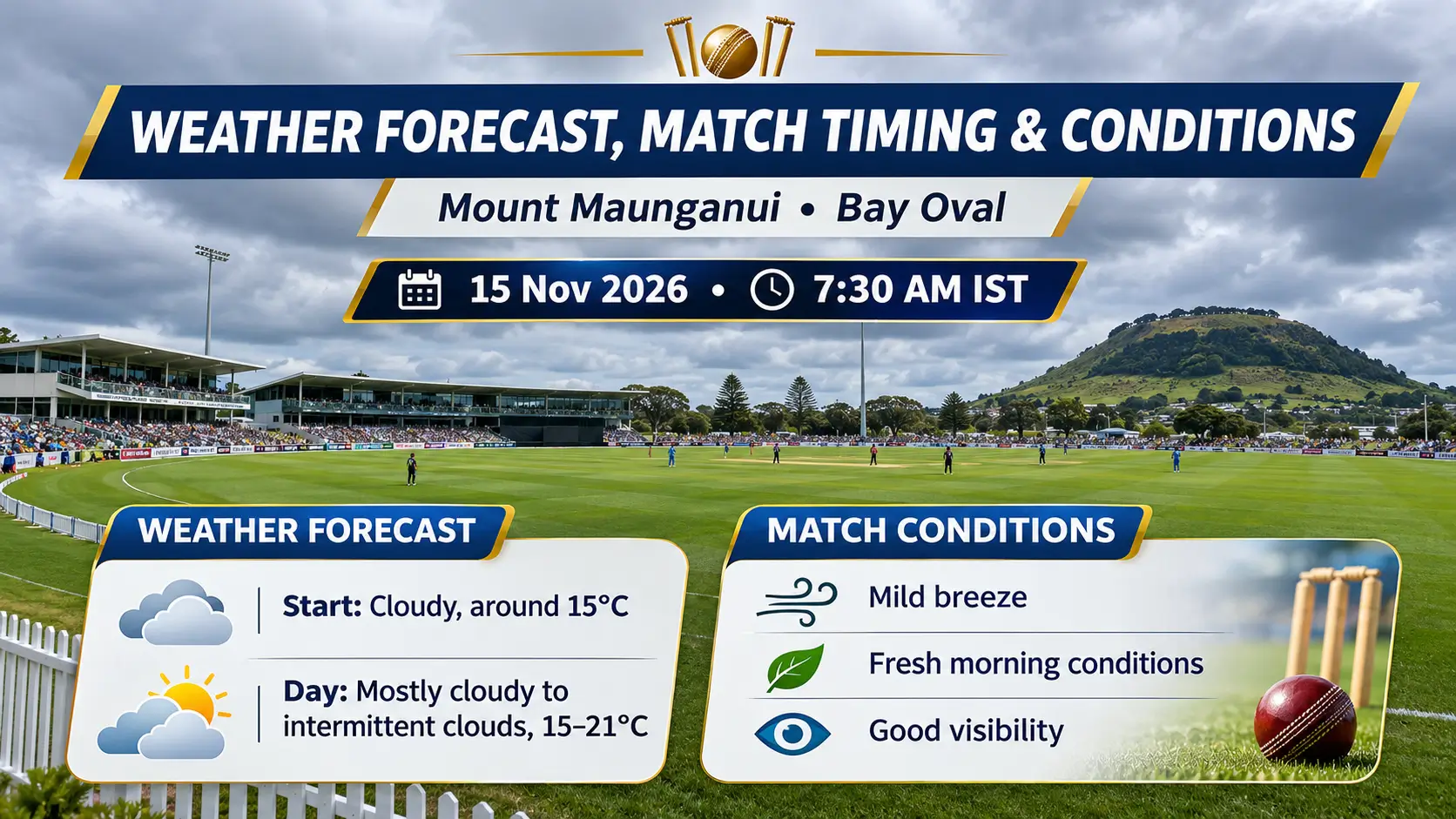
The game is scheduled to begin at 3:00 PM local New Zealand daylight time, corresponding to 7:30 AM in India. This timing matters because a match that starts in the Indian morning is played in the New Zealand afternoon. Daylight, temperature and overhead cloud conditions can therefore be different from what an Indian viewer might imagine from the broadcast time.
Published previews suggest a mixture of sunshine and cloud, temperatures around 19°C and a limited chance of a shower. This is a forecast, not a guaranteed match-day observation. The precise weather and any rain threat should be checked again before publication and on the morning of the fixture; local conditions can change with relatively little warning.
What if rain interrupts play?
An interruption could change the number of overs and therefore the value of wickets in hand. Teams may need to attack earlier or preserve resources differently in a shortened contest. Forecast uncertainty makes it unwise to publish a rigid winner prediction based on a full 50-over match without acknowledging the possibility of altered conditions.
Any DLS-adjusted target would depend on the actual overs lost, wickets and official calculations. Predicting a precise revised target before an interruption would be misleading. The most reliable preparation is to monitor the latest forecast and follow the official match centre once play begins.
NZ vs IND 5th ODI 2026 Match Prediction: Who Will Win?
On the evidence available on 14 November, New Zealand have a narrow pre-match edge because they have just outplayed India at the same venue and their batting combinations looked settled on Friday. However, that assessment is less decisive once Henry and Jamieson’s absence is considered. Their replacements face the difficult task of confronting India’s senior batting lineup.
India’s path to victory is equally realistic. They hold a 2–1 series lead, have already won twice on tour, and can correct several identifiable errors from the fourth ODI. If the top order avoids early dismissals and the fielders take their chances, India can prevent New Zealand from building the same momentum. It would be a mistake to use 89 all out as the only indicator of India’s batting strength.
| Factor | New Zealand | India |
|---|---|---|
| Recent match at Bay Oval | Won by 244 runs | Dismissed for 89 |
| Series standing | Trail 1–2 | Lead 2–1 |
| Batting positives | Young 125, Seifert 58, Allen 41 | Kishan, Axar and Dhir resisted briefly |
| New-ball issue | Henry and Jamieson unavailable | Must survive early movement |
| Main opportunity | Repeat partnerships, replace pace wickets | Secure opening platform and improve catching |
Scenario one: New Zealand bat first
Young and Seifert will be central to the opening phase if selected. A productive first 15 overs would allow the middle order to attack without taking reckless risks. India’s challenge will be to dismiss set batters rather than simply slow the rate, particularly after seeing New Zealand turn early missed chances into a 333-run total.
India could still be well placed if early wickets expose the reshaped middle order. On a surface offering some movement, the first hour may matter more than any pre-match average score. The quality of India’s catching and bowling discipline would be decisive variables.
Scenario two: India bat first
New Zealand’s new seam combination becomes the biggest uncertainty. If the home attack finds the same line and length as Henry, India’s top order will again face an examination. If it cannot maintain that control, the experienced Indian batters have an opportunity to rebuild their confidence and set a substantial total.
Frequently Asked Questions About the 5th ODI
When is the India vs New Zealand 5th ODI 2026?
The fifth ODI is scheduled for Sunday, 15 November 2026. It starts at 7:30 AM IST, which is 3:00 PM local time in New Zealand.
Where will the NZ vs IND 5th ODI be played?
The match will take place at Bay Oval in Mount Maunganui, New Zealand. The same ground hosted the fourth ODI on 13 November.
Who is likely to win the fifth ODI?
New Zealand hold a slight form advantage after winning the fourth ODI emphatically, but the forecast is uncertain. India lead the series and may benefit from changes to New Zealand’s pace attack; the toss and confirmed XIs could change the assessment.
What is the average ODI score at Bay Oval?
One published venue dataset lists an average first-innings score of 268 from 13 men’s ODIs. Different websites use different match samples, so averages should always be read with their source and time period.
Will Matt Henry play the fifth ODI?
Current team news indicates that Matt Henry is unavailable for this match as he moves to Test preparations. Kyle Jamieson is also unavailable, and Jacob Duffy is among New Zealand’s pace options.
What is the India vs New Zealand ODI series score?
India lead the five-match series 2–1 entering the final ODI. New Zealand can level the series at 2–2 with a victory, while India can finish 3–1 ahead.
Conclusion: The Final Bay Oval Test for Both Teams
The NZ vs IND 5th ODI 2026 Match Prediction is finely balanced despite the dramatic scoreline on Friday. Young’s century and Henry’s six wickets explain why New Zealand are confident, but the home team will be without two important seamers for the final fixture. India have to show a more measured response against the new ball and make their chances count in the field.
The strongest conclusion is a conditional one: New Zealand appear marginally better placed on recent performance at Bay Oval, while India have the experience and series results to reverse that momentum. Fans should use the confirmed match time, official team sheets and conditions at the toss rather than treating any advance prediction as a guaranteed outcome. Follow the official BCCI fifth-ODI match centre for match-day details and the final result.
Research verification date: 14 November 2026. All predicted XIs, weather outlooks and winner assessments are pre-match and subject to change.