
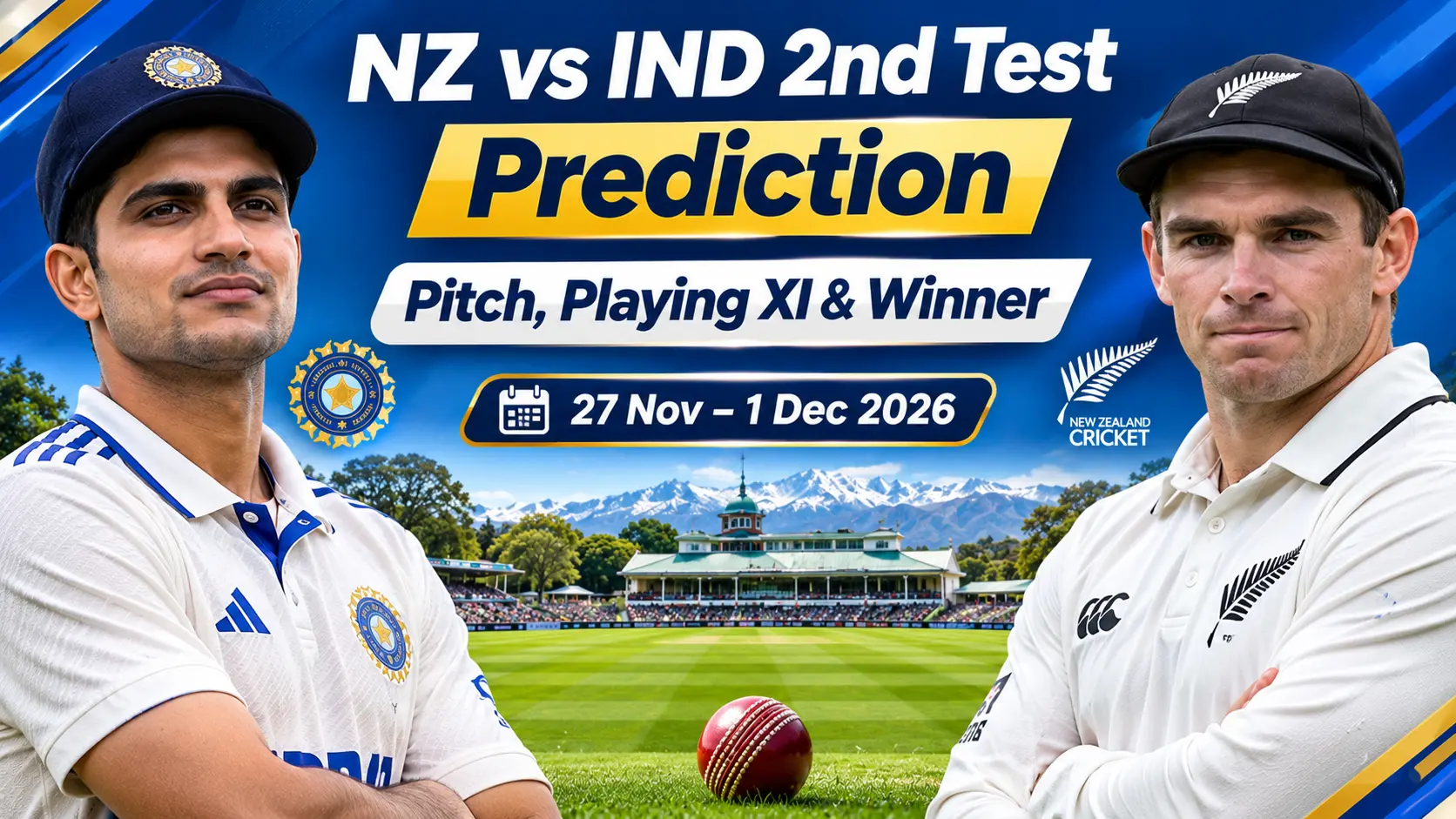
New Zealand and India will meet in the second and final Test at Hagley Oval in Christchurch from 27 November to 1 December 2026. After the opening Test in Wellington ended in a draw, both teams will be aiming for a win to claim the series. Christchurch’s seam-friendly conditions could give the hosts a slight advantage, but India’s strong batting line-up makes this a closely contested match.
The first match at Basin Reserve showed the strengths of both sides. India piled up 720/9 declared, while New Zealand responded with 368 in the first innings and then defended superbly to finish on 239/5 in the second. The result left the two-match series level and raised the importance of the Christchurch game.
This NZ vs IND 2nd Test prediction examines the Hagley Oval pitch, recent performances, squad updates, probable playing XIs and the key battles that may decide the result. The selections below are projections based on information available on 24 November 2026; the captains will confirm their final teams at the toss.
NZ vs IND 2nd Test Match Details and Series Context
The second Test is scheduled to begin on Friday, 27 November, at 11:00 AM in Christchurch. For viewers in India, the first ball is scheduled for 3:30 AM IST. The match is the final fixture of the two-Test series and forms part of the 2025–27 World Test Championship cycle.
| Match detail | Information |
|---|---|
| Fixture | New Zealand vs India, 2nd Test |
| Series | India tour of New Zealand 2026 |
| Dates | 27 November to 1 December 2026 |
| Ground | Hagley Oval, Christchurch |
| Local start | 11:00 AM |
| India start | 3:30 AM IST |
| Series position | Second and final Test |
| First-Test result | Drawn at Basin Reserve, Wellington |
The draw in Wellington was significant beyond the series score. The ICC reported that New Zealand moved to third in the WTC standings with a 66.67 per cent points percentage, while India were fourth on 50 per cent after the result. Both teams therefore have a strong reason to pursue a positive result rather than settle for another stalemate.
For the wider competition picture and official tournament updates, readers can follow the ICC’s latest World Test Championship standings update. For additional site updates, visit the Taj777 website.
Hagley Oval Pitch Report and Weather Factors
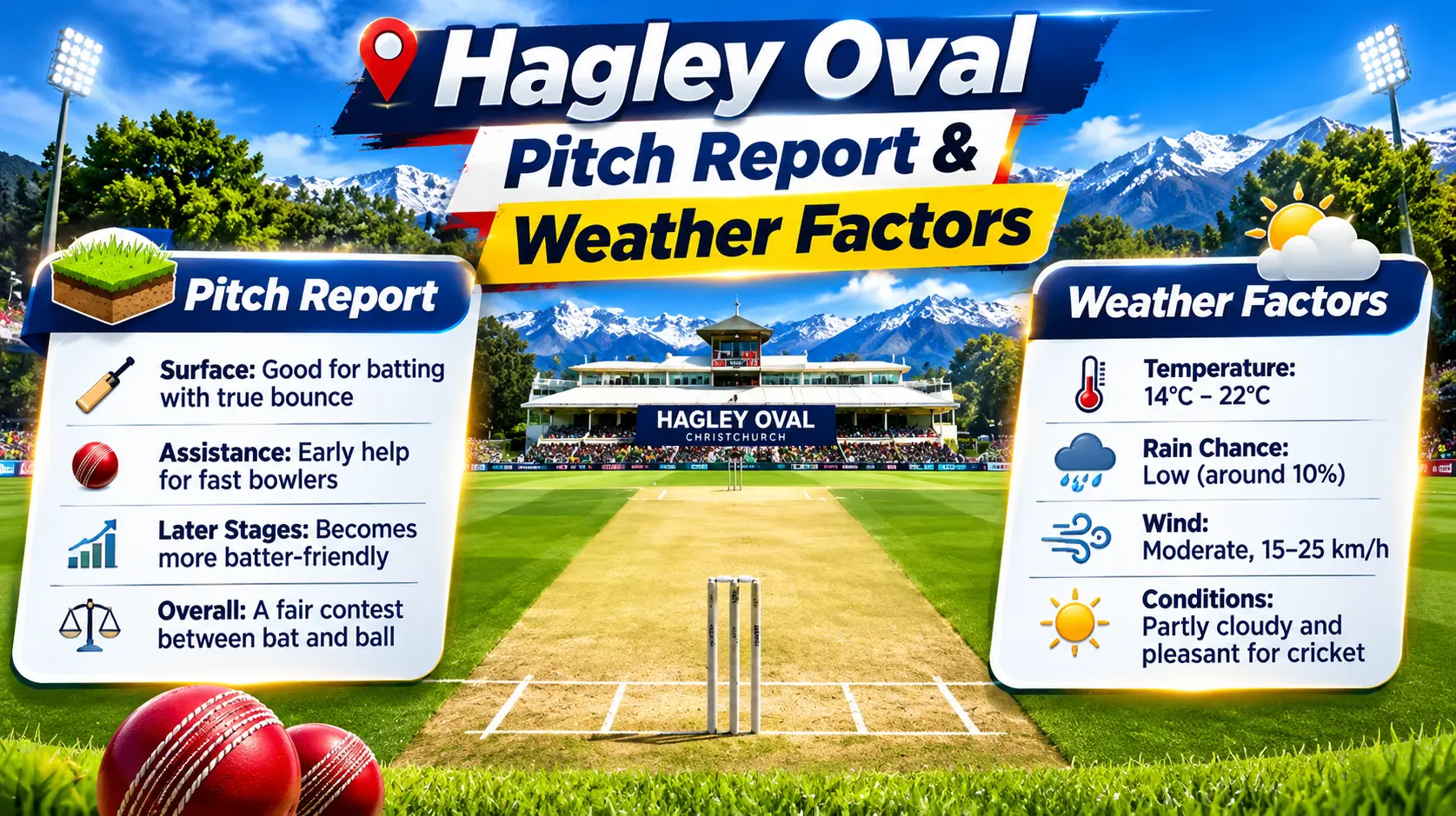
Hagley Oval is known for offering assistance to fast bowlers, especially when the ball is new and the surface has a covering of grass. Seam movement and bounce can trouble batters during the opening session. The pitch can become more comfortable for batting as the match progresses, provided players survive the early movement and settle into their innings.
Historical Test figures at the venue underline why captains often prefer to bowl first. In 15 Tests at Hagley Oval, 14 toss-winning captains chose to field. The average first-innings total is approximately 288.9, while the record first-innings total is 659/6 declared. The lowest completed innings total is 95.
| Hagley Oval Test record | Figure |
|---|---|
| Tests hosted | 15 |
| Average first-innings total | 288.9 |
| Highest team total | 659/6 declared |
| Lowest team total | 95 |
| Highest successful fourth-innings chase | 285/8 |
| New Zealand wins at the venue | 9 |
| New Zealand defeats at the venue | 4 |
| Draws at the venue | 2 |
How the pitch may behave across five days
On the first morning, the seamers are likely to test the outside edge with a fuller length and disciplined lines. If there is cloud cover or moisture in the surface, the opening spell could be particularly demanding. Batters will need to leave deliveries carefully and avoid chasing balls outside off stump.
Once the shine wears off and the surface settles, stroke-making should become easier. A first-innings total around 300 would be a useful competitive benchmark, although the actual par score will depend on grass coverage, weather and how quickly the pitch dries. Later in the match, rough patches and footmarks may bring the spinners into play.
Weather and toss prediction
Weather can change quickly in Christchurch, and a reliable five-day forecast should be checked closer to the start. Do not treat a long-range forecast as confirmed match-day information. Rain interruptions could reduce overs and increase the possibility of a draw, while clear conditions would give both teams more time to force a result.
The toss winner may prefer to field first if the pitch offers visible grass, early moisture or useful cloud cover. If the surface looks dry and firm, batting first becomes a more reasonable option. The toss call should therefore be based on the final inspection rather than a fixed assumption.
First Test Review: What Wellington Told Us
The opening Test produced a huge Indian first-innings total but still ended without a winner. New Zealand’s ability to recover from a difficult start and then bat out the final innings was the defining feature of the match.
| Innings | Score | Key detail |
|---|---|---|
| New Zealand 1st innings | 368 all out | Henry Nicholls 175, Glenn Phillips 118 |
| India 1st innings | 720/9 declared | KL Rahul 136, Rishabh Pant 128 |
| New Zealand 2nd innings | 239/5 | Devon Conway 65, Daryl Mitchell 49 not out |
| Result | Draw | New Zealand survived the final day |
India’s batting gives them confidence
India’s 720/9 declared was the strongest statement of the match. KL Rahul’s 136 provided a long, composed innings, while Rishabh Pant’s 128 added momentum. Yashasvi Jaiswal made 85, Devdutt Padikkal scored 80, and Shubman Gill contributed 98. The depth of the batting order allowed India to build a substantial lead.
That performance should give the visitors confidence at Hagley Oval. However, the Christchurch surface may ask different questions from the Wellington pitch. India’s top order must be prepared to handle the moving ball and avoid losing several wickets in the first session.
New Zealand showed patience under pressure
New Zealand’s first innings was rescued by Henry Nicholls and Glenn Phillips after the side had lost early wickets. Nicholls made 175 from 335 balls, while Phillips scored 118 from 216 deliveries. Their partnership turned a difficult position into a competitive total.
The second innings required a different kind of effort. Devon Conway scored 65, Daryl Mitchell remained unbeaten on 49, and Glenn Phillips helped New Zealand reach the close without another collapse. Their resistance exposed the challenge India may face if the Christchurch pitch becomes less helpful to bowlers.
Updated Squads and Injury News
Squad updates are important for this fixture because New Zealand have lost bowling depth before the Christchurch Test. Blair Tickner has been ruled out with a hamstring injury, and Matt Fisher has been added to the 14-player group. Mitchell Santner is also unavailable after a finger injury, with Dean Foxcroft included in the updated squad.
New Zealand updated squad
Blair Tickner and Mitchell Santner are unavailable for the Christchurch Test. Matt Fisher and Dean Foxcroft are part of the updated squad. The final XI is not confirmed.
India Test squad
India’s updated squad was announced by the BCCI after Gurnoor Brar replaced Kuldeep Yadav in the touring group. The selected playing XI will be announced at the toss.
NZ vs IND Probable Playing XI
The following combinations are projections based on the first Test, the available squad information and the expected conditions at Hagley Oval. They are not official team announcements. Changes remain possible after the final pitch inspection and fitness checks.
New Zealand probable XI
| Role | Players |
|---|---|
| Openers | Tom Latham (C), Devon Conway |
| Middle order | Henry Nicholls, Rachin Ravindra, Daryl Mitchell |
| Wicketkeeper | Tom Blundell (WK) |
| All-round option | Glenn Phillips |
| Seam attack | Nathan Smith, Kyle Jamieson, Matt Henry, Jacob Duffy |
New Zealand’s main selection question is whether to retain the bowling combination used in Wellington or bring Matt Fisher into the XI after his squad call-up. Fisher’s inclusion would give the hosts another pace option, but the team may prefer the experience and balance of its established attack. Dean Foxcroft provides another batting and spin option if the surface does not demand four specialist seamers.
India probable XI
| Role | Players |
|---|---|
| Openers | Yashasvi Jaiswal, KL Rahul |
| Top and middle order | Devdutt Padikkal, Shubman Gill (C), Rishabh Pant (WK) |
| Lower middle order | Anshul Kamboj, Dhruv Jurel |
| All-rounder | Washington Sundar |
| Fast bowlers | Akash Deep, Jasprit Bumrah, Prasidh Krishna |
India may be tempted to retain the combination that scored heavily in Wellington. The major discussion points are whether Mohammed Siraj returns to strengthen the pace attack and whether Ravindra Jadeja is selected to provide a second spin option and batting depth. The team management must balance the value of extra pace with the need for lower-order runs.
Key Players and Match-Winning Battles
Jasprit Bumrah vs New Zealand’s top order
Bumrah was India’s leading wicket-taker in the first innings at Wellington with four wickets for 92 runs. His ability to move the ball both ways and maintain accuracy makes him a major threat at Hagley Oval. The opening spell against Tom Latham and Devon Conway could shape the match. If Bumrah finds movement early, India can put New Zealand under pressure before the middle order settles.
Matt Henry and Kyle Jamieson vs India’s openers
Henry and Jamieson are important to New Zealand’s chances because the Christchurch surface often rewards disciplined seam bowling. They will look to attack the channel outside off stump and make Jaiswal and Rahul play regularly. India’s openers must judge the line carefully, leave well and punish loose deliveries rather than force scoring shots.
Rishabh Pant and Glenn Phillips in the middle overs
Pant’s 128 in Wellington showed how quickly he can change the tempo of a Test innings. Phillips also proved his value with a century and a patient contribution in the second innings. Both players can influence the match through counter-attacking batting, but their decisions against short-pitched bowling and spin will matter.
All-round balance: Washington Sundar, Rachin Ravindra and Daryl Mitchell
Washington Sundar gives India control and batting depth, while Ravindra and Mitchell provide New Zealand with flexibility. Their contributions may become especially important if the pitch slows down. The side that gets more overs and runs from its all-rounders could gain a decisive advantage in a closely matched contest.
Head-to-Head Record and WTC Standings
India hold the overall advantage in the historical Test rivalry, but New Zealand’s home record makes the Christchurch contest more balanced. The latest available historical count lists 65 Tests between the sides, with India winning 22, New Zealand winning 16 and 27 ending in draws. New Zealand also won the most recent Test series between the teams, a 3–0 result in India in 2024.
| Test head-to-head | Matches |
|---|---|
| Total Tests | 65 |
| India wins | 22 |
| New Zealand wins | 16 |
| Draws | 27 |
At the time of the Wellington draw, New Zealand were third in the WTC table on 66.67 per cent, while India were fourth on 50 per cent. A win in Christchurch would be valuable for both teams. New Zealand would strengthen their position among the leading contenders, while India would improve their percentage and keep pressure on the teams above them.
NZ vs IND 2nd Test Prediction: Who Will Win?

This is a close contest, but New Zealand receive a narrow advantage because of home conditions and the characteristics of Hagley Oval. Their seamers know how to use the Christchurch surface, and the first morning could provide an opportunity to put India’s top order under pressure. The absence of Tickner and Santner, however, reduces the depth of the hosts’ options.
India have reasons to be confident. Their first-innings total of 720/9 in Wellington demonstrated substantial batting depth, while Bumrah, Akash Deep and Prasidh Krishna can challenge New Zealand if the pitch offers movement. As the NZ vs IND Test Series 2026 reaches its final match, the visitors must avoid an early collapse and convert promising starts into long partnerships.
Factors that could decide the winner
- First-session wickets: The team that controls the new ball may dictate the opening day.
- First-innings total: A score around 300 or more should provide a useful platform, subject to conditions.
- Middle-order partnerships: Rahul, Gill and Pant for India; Nicholls, Mitchell and Phillips for New Zealand.
- Bowling workload: New Zealand must manage its pace resources after the latest injury news.
- Weather and overs: Lost time could make a draw more likely.
Frequently Asked Questions
When is the NZ vs IND 2nd Test 2026?
The second Test is scheduled from 27 November to 1 December 2026. It will be played at Hagley Oval in Christchurch.
What time does the New Zealand vs India 2nd Test start in India?
The match is scheduled to begin at 3:30 AM IST. The local start time in Christchurch is 11:00 AM.
Where will the second Test between New Zealand and India be played?
The match will take place at Hagley Oval, Christchurch, New Zealand. The venue is known for offering early assistance to fast bowlers.
Who is the favourite to win the NZ vs IND 2nd Test?
New Zealand have a slight advantage because they are playing at home and Hagley Oval can help seamers. India remain strong contenders after scoring 720/9 declared in the first Test.
Is Blair Tickner playing the Christchurch Test?
No. Blair Tickner has been ruled out with a hamstring injury. Matt Fisher has been added to New Zealand’s squad as his replacement.
What happened in the first NZ vs IND Test in 2026?
The first Test at Basin Reserve in Wellington ended in a draw. New Zealand scored 368 and 239/5, while India made 720/9 declared in their only innings.
The NZ vs IND 2nd Test Prediction points towards a competitive match in Christchurch, with New Zealand holding a small advantage because of familiar home conditions and the possibility of early seam movement. India’s batting performance in Wellington means the visitors should not be underestimated. The toss, the first session and the ability to build long partnerships will be decisive.
New Zealand may start as narrow favourites, but India have the quality to turn the contest in their favour. The final playing XIs, pitch inspection and match-day weather will provide the clearest picture before the first ball. Follow the latest team updates and score developments as the series reaches its final Test.