

The India vs NZ 1st Test 2026 at Basin Reserve in Wellington ended in a draw after New Zealand produced a determined batting effort on the final day. India had built a huge first-innings advantage by scoring 720/9 declared, but the hosts finished at 239/5 in their second innings and survived the remaining overs. The result left the two-match series level at 0-0.
Match result: Draw
Venue: Cello Basin Reserve, Wellington, New Zealand
Dates: 19–23 November 2026
Score: New Zealand 368 and 239/5; India 720/9 declared
Key resistance: Daryl Mitchell 49 not out and Glenn Phillips 26 not out in the second innings
Quick answer: The first India-New Zealand Test of 2026 finished as a draw at Wellington. New Zealand made 368 in their first innings, India replied with 720/9 declared, and the hosts closed their second innings on 239/5 after batting for 120 overs. India led by 352 runs after the first innings but could not take all ten wickets.
Innings score comparison
Bars compare runs scored in each completed innings; India’s declared innings is the reference maximum.
India vs NZ 1st Test 2026: Match Result and Overview
The opening Test of India’s 2026 tour of New Zealand was played at the Cello Basin Reserve from 19 to 23 November. India won the toss and chose to field, backing their pace attack to make early use of the Wellington conditions. New Zealand were dismissed for 368 in 121 overs in their first innings.
India then took control with a commanding 720 runs at the loss of 9 wickets declared from 166 overs. The total gave the visitors a first-innings lead of 352 runs and left them with a substantial amount of time to bowl New Zealand out again. The declaration created a clear route to victory, but the pitch became increasingly difficult for the bowlers to exploit.
New Zealand’s second innings was built around patience rather than quick scoring. They reached 239/5 in 120 overs before both teams agreed to end the match. India were five wickets short of a win, while New Zealand had successfully defended their position through a long final-day effort.
Cricket enthusiasts who follow matches and tournaments can also explore an Online Cricket ID to learn about online cricket platforms and their features.Full India vs New Zealand 1st Test 2026 Scorecard
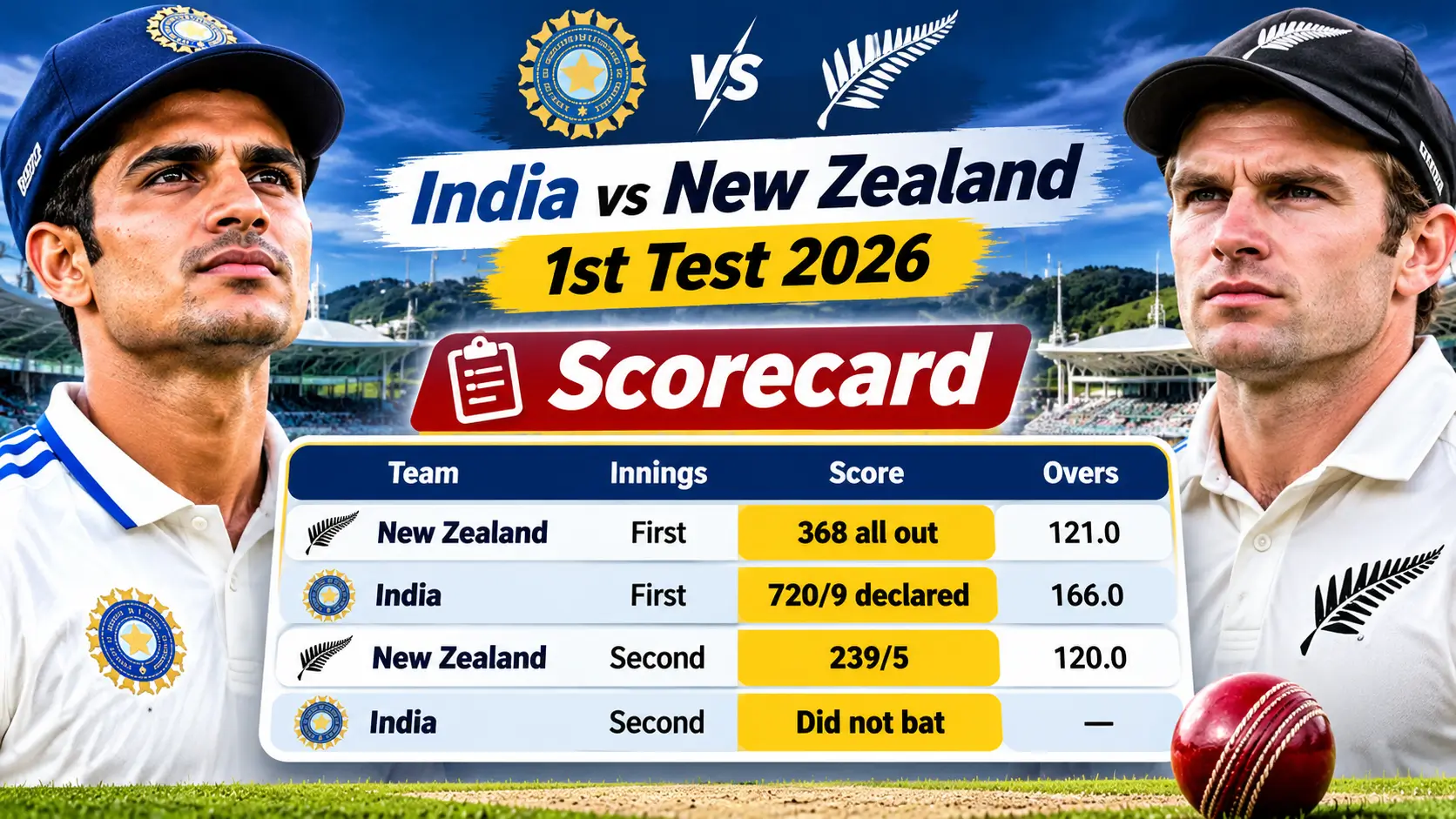
Match score summary
| Team | Innings | Score | Overs |
|---|---|---|---|
| New Zealand | First | 368 all out | 121.0 |
| India | First | 720/9 declared | 166.0 |
| New Zealand | Second | 239/5 | 120.0 |
| India | Second | Did not bat | — |
India first innings: 720/9 declared
India’s batting effort was the defining feature of the match. KL Rahul top-scored with 136 from 290 deliveries, combining concentration with careful shot selection. Rishabh Pant added 128 from 153 balls, bringing counter-attacking intent to the middle order and accelerating the scoring rate.
Yashasvi Jaiswal made 85 from 89 balls, while Devdutt Padikkal contributed 80 from 175 deliveries. Shubman Gill narrowly missed a hundred, scoring 98 from 146 balls. Dhruv Jurel’s 78 from 79 balls added further momentum late in the innings.
| India batter | Runs | Balls |
|---|---|---|
| KL Rahul | 136 | 290 |
| Rishabh Pant | 128 | 153 |
| Yashasvi Jaiswal | 85 | 89 |
| Devdutt Padikkal | 80 | 175 |
| Dhruv Jurel | 78 | 79 |
| Shubman Gill | 98 | 146 |
The innings showed two different approaches working together. Rahul and Padikkal provided long periods of stability, while Pant, Jaiswal and Jurel ensured that the scoring did not become static. Gill’s 98 was another important contribution in a total that put New Zealand under sustained pressure.
New Zealand first innings: 368 all out
New Zealand’s first innings began poorly. Captain Tom Latham was dismissed for a duck, and the home side lost early wickets as India’s fast bowlers attacked the stumps and tested the outside edge. Henry Nicholls then produced a superb innings of 175 not out from 335 balls.
Glenn Phillips supported him with 118 from 216 deliveries. Their partnership transformed the innings after New Zealand had slipped into trouble. The pair added 216 runs for the sixth wicket, taking the score from 70/5 to 286/6 and giving the hosts a respectable total.
| New Zealand batter | Runs | Balls |
|---|---|---|
| Henry Nicholls | 175 not out | 335 |
| Glenn Phillips | 118 | 216 |
| Nathan Smith | 14 | 44 |
| Rachin Ravindra | 15 | 50 |
Jasprit Bumrah led India’s bowling with four wickets for 92 runs. Akash Deep claimed three wickets, while Anshul Kamboj took two. The early breakthroughs were important, but Nicholls and Phillips ensured that New Zealand did not collapse for a low total.
One of the decisive phases came before the final day, when India converted a strong start into a total of 720. The innings lasted 166 overs, so New Zealand’s bowlers had to spend long periods in the field. That workload mattered when the home side returned to bat: India could attack with a large lead, but the pitch had also become older and less responsive.
The match situation explains why the draw was not simply a matter of New Zealand scoring quickly. The hosts needed to protect wickets over a full day, while India needed regular breakthroughs. Once Mitchell and Phillips settled, the contest became a test of patience, fielding discipline and time management rather than a race for runs.
How New Zealand Saved the Test
India began the final day needing eight wickets to win. New Zealand resumed at 119/2, still trailing by 233 runs, and had to balance survival with the need to keep the scoreboard moving. The morning session initially gave India hope as Washington Sundar removed Devon Conway for 65 and Prasidh Krishna dismissed Rachin Ravindra for 37.
Tom Blundell made 15 before Anshul Kamboj took his wicket, leaving New Zealand five down. At that stage, India still had a realistic opportunity to force a result. However, the remaining batters made the task increasingly difficult by defending with discipline and refusing to offer easy chances.
Mitchell and Phillips frustrate the Indian attack
Daryl Mitchell and Glenn Phillips became the central figures of the final session. Mitchell finished unbeaten on 49 from 186 balls, while Phillips remained not out on 26 from 126 deliveries. Their unbroken sixth-wicket stand was worth 63 runs and consumed valuable time.
India tried pace, spin and changes in field placement, but the pair continued to block deliveries outside their scoring areas. As the final overs passed, the possibility of an Indian victory faded. The captains eventually shook hands with the final hour still remaining, confirming the draw.
The final-day effort was a reminder of the value of defensive batting in Test cricket. New Zealand did not need to chase the target; their task was to preserve wickets and use the available time. Mitchell and Phillips executed that plan successfully.
Top Performers and Important Match Records
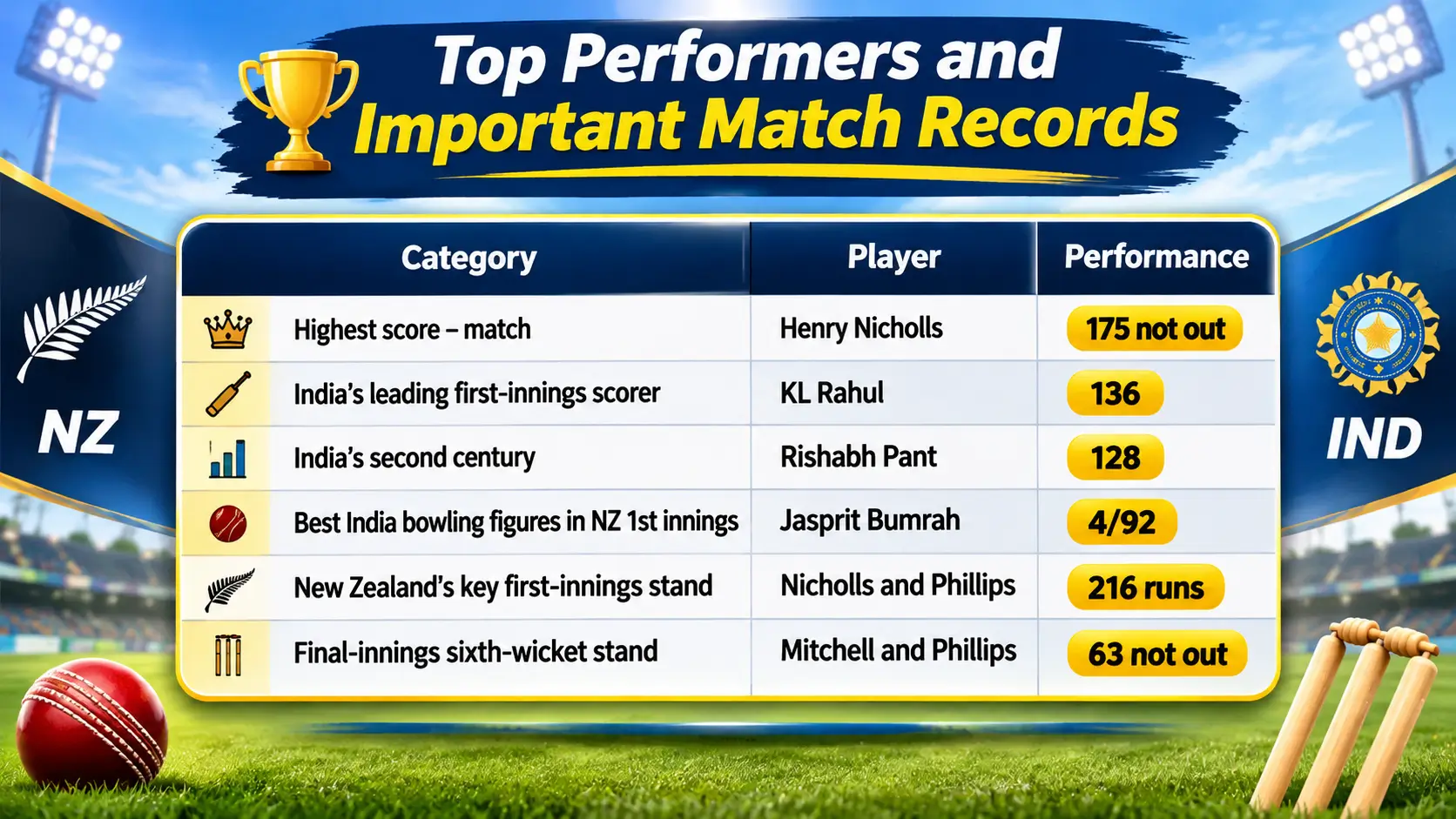
| Category | Player | Performance |
|---|---|---|
| Highest score – match | Henry Nicholls | 175 not out |
| India’s leading first-innings scorer | KL Rahul | 136 |
| India’s second century | Rishabh Pant | 128 |
| Best India bowling figures in NZ 1st innings | Jasprit Bumrah | 4/92 |
| New Zealand’s key first-innings stand | Nicholls and Phillips | 216 runs |
| Final-innings sixth-wicket stand | Mitchell and Phillips | 63 not out |
Several performances shaped the contest. Rahul’s 136 and Pant’s 128 helped India establish a massive lead, while Nicholls and Phillips kept New Zealand in the game during the first innings. Bumrah’s four wickets gave India early control, but the hosts’ late resistance prevented the visitors from completing the job.
India’s first-innings bowling figures also show how the attack shared the work. Bumrah’s four wickets came at the top and through the lower order, while Akash Deep’s three strikes helped remove the middle and tail. Kamboj’s two wickets supported the pressure, but Nicholls and Phillips had already built the partnership that took New Zealand beyond the danger zone.
In the second innings, India again found ways to take wickets, but the scoring rate stayed low and the batters made the bowlers earn every chance. Prasidh Krishna’s two wickets were particularly important in breaking the developing stand between Conway and Ravindra. Sundar and Kamboj also struck, yet the final partnership remained intact when the match was called off.
What the Wellington Test Revealed About Both Teams
India: strong batting, but missed chances with the ball
India can take considerable confidence from scoring 720 runs fall of 9 wickets. The top and middle order produced runs in different conditions and at different tempos, and the team had enough batting depth to declare after building a 352-run lead. The bowling unit also made early inroads in both New Zealand innings.
The main disappointment was the inability to take the final five wickets on Day 5. The surface offered limited assistance as the match progressed, and New Zealand’s batters made India work hard for every breakthrough. For the visitors, the lesson is to convert dominant positions into victories by creating sustained pressure and taking chances when they appear.
New Zealand: resilience and patience earned the draw
New Zealand’s response was built on two substantial partnerships. Nicholls and Phillips rescued the first innings after the team had fallen to 70/5. In the second innings, Conway and Ravindra helped stabilise the top order before Mitchell and Phillips shut India out.
The draw will feel valuable to the home side because they were under pressure for much of the match. Their ability to bat for long periods, especially on the final day, demonstrated the importance of decision-making and composure in a Test match.
Official Scorecard and Match Details
For readers who want the complete batting, bowling, fall-of-wickets and session information, refer to the official BCCI New Zealand vs India 1st Test match centre. It records the match as drawn at Cello Basin Reserve, Wellington, with New Zealand scoring 368 and 239/5 and India making 720/9 declared.
The match was part of India’s 2026 tour of New Zealand and was scheduled from 19 to 23 November. The final scoreline captures the contrast between India’s dominant first-innings batting and New Zealand’s determined resistance across both innings.
India vs NZ 1st Test 2026: Frequently Asked Questions
1. Who won the India vs New Zealand 1st Test in 2026?
The first Test ended in a draw at Basin Reserve, Wellington. India were unable to dismiss New Zealand’s final five batters before the teams agreed to end the match.
2. What was the final score of the India vs NZ 1st Test 2026?
New Zealand scored 368 in the first innings and 239/5 in the second. India made 720/9 declared in their only innings.
3. Who was the highest run-scorer in the match?
Henry Nicholls was the leading individual scorer with 175 not out for New Zealand in the first innings. KL Rahul was India’s top scorer with 136.
4. How many runs did KL Rahul score?
KL Rahul scored 136 from 290 balls in India’s first innings. His innings helped India build a substantial lead over New Zealand.
5. Who scored centuries for India?
KL Rahul scored 136 and Rishabh Pant made 128. Shubman Gill came close to a century with 98, while Yashasvi Jaiswal scored 85.
6. Where was the first Test played?
The match was played at Cello Basin Reserve in Wellington, New Zealand, from 19 to 23 November 2026.
Conclusion
The India vs NZ 1st Test 2026 ended in a draw, despite India’s commanding 352-run first-innings lead. Rahul, Pant and Gill powered India’s huge total, while Nicholls and Phillips led New Zealand’s resistance. The final-day partnership between Mitchell and Phillips ensured the hosts survived. Follow the official scorecard and match centre for verified records, and keep checking for coverage of the next Test in the series.