

Clear rules, real odds and practical safety checks for anyone who wants to understand casino games before making decisions.
Quick answer: Casino guides explain how slots, roulette, blackjack, baccarat and card games work in online and physical settings. They help readers compare game rules, odds, costs and risks. In India, real-money online games are prohibited under the national framework effective from May 2026, while physical casinos follow location-specific laws.
This guide takes the mystery out of those rules. It covers popular games, the difference between real and digital formats, the maths behind prizes, and the checks that matter to Indian readers. It is an educational reference, not an invitation to wager or a claim that any service is legal.
What Casino Guides Explain About Games and Risk
A useful casino guide begins with the question a beginner actually has: what happens during a round? Some games ask players to pick a number or colour. Others involve cards, a dealer and a choice about whether to take another card. Slots work through symbols and a programmed prize table.
But rules alone are not enough. A complete guide should also explain how likely an outcome is, how much the game pays for it, and what it may cost over many rounds. A big displayed prize can be exciting, but it says little about the chance of receiving it. The gap between a prize and its probability is where much of the risk sits.
Three words appear again and again: stake, the amount put at risk in one round; payout, the amount paid when a result qualifies; and house edge, the average advantage built into the game for its operator. These terms help readers make sense of every game family.
Different casino formats, one basic question
For readers in India, that difference matters most. The same card game can appear as a social game with no monetary reward, a paid online product, or a table game in a licensed physical venue. The legal treatment can differ by format and location. Always check the current rules rather than relying on a site’s advertising.
| Term | Simple meaning | Why it matters |
|---|---|---|
| Stake | Amount risked in a round | Controls potential loss per round |
| Payout | Payment for a qualifying result | Must be read with the probability |
| House edge | Long-run average operator advantage | Shows expected cost of repeated play |
| RTP | Return to player over many rounds | Not a promise for one session |
Popular Casino Games: Rules and Main Differences
The most helpful way to learn online casino games is to group them by how a result is decided. A wheel uses a numbered layout. Card games use dealt hands. Slot machines use digital symbols. Players may make decisions in some games, but that does not remove the role of chance or guarantee a profit.
Roulette: a ball, a wheel and numbered pockets
In roulette, a small ball stops in one of the wheel’s pockets. A standard European wheel has numbers 1 to 36 plus one zero. A standard American wheel adds a double zero, creating 38 pockets. Bets can concern one number, several numbers, a colour, or whether the result is odd or even.
Blackjack: reaching 21 without going over
Blackjack asks a player to make a hand closer to 21 than the dealer’s without exceeding 21. Number cards count at face value, face cards count as ten, and an ace usually counts as one or eleven. A player can normally take another card or stand, with extra options depending on the table.
Baccarat: two hands and fixed drawing rules
Baccarat compares a Player hand and a Banker hand. These are names of the two sides of the game; a reader does not need to be a bank or a professional player. Hands use a point system where only the last digit of the total counts. Additional cards are drawn according to fixed rules.
Slots: symbols, paylines and random outcomes
A slot game shows reels or a grid of symbols. Its rule screen explains matching patterns, special symbols, bonus features and payment amounts. Digital slots use a random number generator, or RNG, to select outcomes. The animation on screen presents the result; it does not give players control over the next spin.
Teen Patti, Andar Bahar and poker
Indian readers may also know Teen Patti and Andar Bahar. Teen Patti uses three-card hands and has variations in which players compare hand ranks. Andar Bahar uses a matching-card result with cards dealt to two sides. House rules can change how these formats operate.
| Game | How a result is decided | Key detail to check |
|---|---|---|
| Roulette | Numbered wheel and ball | One zero or two |
| Blackjack | Cards and player decisions | Table-specific rules |
| Baccarat | Two hands under fixed drawing rules | Outcome and payment terms |
| Slots | Programmed random outcome | RTP, volatility and paytable |
| Teen Patti / poker | Card ranks and format rules | House game or player-versus-player |
Online vs Offline Casinos: What Changes?

An offline casino is a physical venue. Players can see tables, cards, machines and other guests. In an online format, a screen provides the game and its instructions. A live-dealer stream sits between the two: a physical dealer appears on video while the visitor connects remotely.
The basic rules of a game may stay similar across formats. European roulette still has one zero whether it is shown on a computer or on a physical wheel. Yet the speed, experience, access rules and ways to check information can differ sharply.
Speed and social experience
At a physical table, a dealer runs each round and people may talk or watch before taking part. Digital games can present a new round almost at once. That speed can make losses build faster than expected because the total amount staked grows with every repeated action.
How fairness is checked
A physical table depends on equipment, procedures and supervision. A digital RNG game depends on software, game settings and independent testing under the rules of a relevant regulator. A live stream does not by itself prove that a service is authorised for a user’s location.
Not every advertised “online casino” has the same oversight. A licence from another country is not a substitute for permission under Indian law. For Indian readers, the first question is whether the format is permitted at all; questions about game selection and features come later.
| Feature | Online format | Offline venue |
|---|---|---|
| Setting | Phone or computer screen | In-person premises |
| Game pace | Can be very fast | Often follows dealer or machine pace |
| Interaction | Menus, chat or live stream | Dealer and other visitors |
| Rule access | Help screen and paytable | Posted rules and staff |
| Legal check in India | National online-money-game prohibition | State-specific licensing and conditions |
Casino Odds, RTP and House Edge Explained
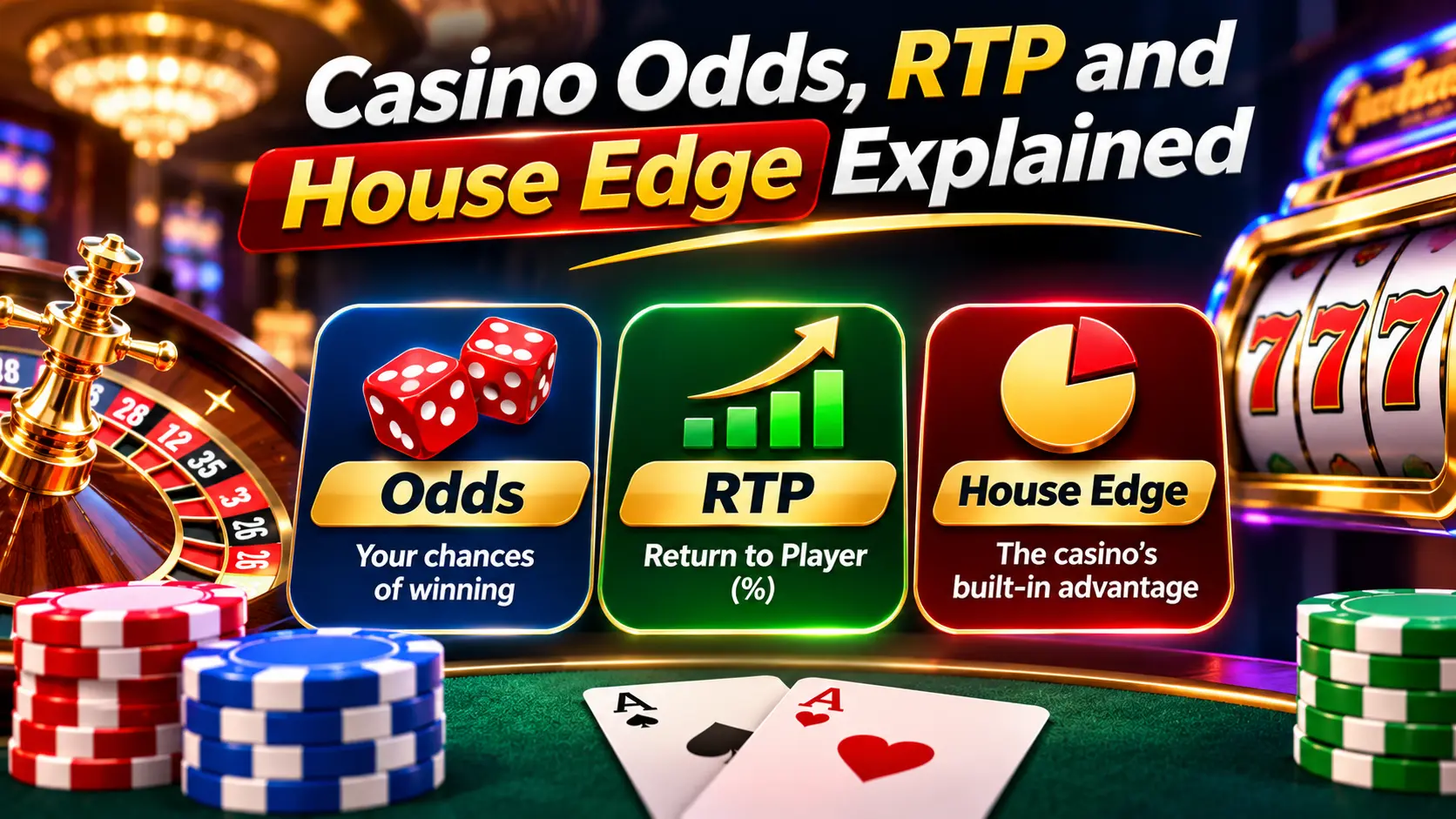
Numbers are the most important part of any honest casino guide. The house edge is the average share of total stakes the game is designed to retain over many rounds. Return to player, or RTP, expresses the average share returned as prizes. In the usual simple model, RTP equals 100% minus the house edge.
For example, a slot designed with 96% RTP has a theoretical 4% house edge. That does not mean a person who stakes ₹100 will receive exactly ₹96. They could receive nothing, a small payment or a rare larger prize. The percentage describes a very large pool of rounds, not one person’s evening.
Why the extra zero matters in roulette
Consider a straightforward red-or-black comparison. A single-zero European wheel contains 37 pockets, of which 18 are red and 18 are black. The remaining pocket is green. The standard house edge on this wheel is about 2.70%.
A standard American wheel has a further green double-zero pocket, making 38 pockets. With standard payments, its house edge is about 5.26%. The rules may seem almost identical to a casual observer, but one extra outcome nearly doubles the mathematical advantage for the house.
| Wheel | Total pockets | House edge | Expected loss on ₹10,000 total stakes |
|---|---|---|---|
| European | 37 | About 2.70% | About ₹270 |
| American | 38 | About 5.26% | About ₹526 |
The last column is a mathematical illustration, not a forecast. “Total stakes” means all wagers added together, even when the same money is used across several rounds. The final amount lost or gained in any short session may be very different.
Volatility is not the same as fairness
Volatility describes how uneven the results can feel. Some games produce many small payments; others have long stretches with little return. Two games can show the same RTP and still create very different experiences. A game is not “due” to pay because it has not paid recently.
How to Read Game Rules, Bonuses and Website Claims
A game screen often makes the largest prize very easy to see. Its detailed conditions may be less obvious. A good first step is to find the full paytable or rule sheet. Look for which results qualify, what payments mean, whether a bonus feature has special rules, and whether any limits apply.
In card games, small rule changes matter. One blackjack table may use different dealer rules or payment terms from another. In roulette, the type of wheel changes the odds. In slots, the same-looking game can sometimes be configured with different theoretical returns. Check the information for the exact version rather than relying on a broad category description.
Understand bonus wording without chasing offers
Promotions may advertise extra credits, matches or free rounds. Their headline amount is not the same as cash available to withdraw. Conditions can include playthrough requirements, eligibility rules, time limits and restrictions on where a credit applies. Some promotions can increase the amount a person risks before any withdrawal is possible.
For Indian readers, a bonus does not make an otherwise prohibited real-money online game lawful. A claim that a website operates overseas, accepts a certain payment method or has many users does not answer whether it can legally serve people in India.
Public marketing also deserves a critical eye. A website’s own description, such as the Taj777 website overview, can show what that business claims to offer. It should never be treated as independent proof of licensing, fair outcomes, lawful access or successful withdrawals.
Look for evidence instead of promises
If you are studying casino games for general interest, free non-monetary demonstrations and written rules can teach the same core mechanics without exposure to the risks of wagering. The best guide helps a reader understand the choice, including the choice not to participate.
Are Online and Offline Casino Games Legal in India?
This is the most important India-specific question in the article. The country now has a national legal framework for online gaming, while the operation of physical casinos is also shaped by state laws. The word “casino” alone does not decide legality; the activity, payment structure, venue and current law all matter.
India’s national rule for online money games
The Promotion and Regulation of Online Gaming Act, 2025 and its operational rules took effect on 1 May 2026. The framework prohibits online money gaming services and related activities covered by the legislation, while providing for permissible online social games and e-sports. A real-money game is not automatically exempt merely because it involves skill.
The government explains this distinction in its official online gaming rules announcement. It describes how authorities identify online money games and address enforcement, user protection and payment flows.
This means an overseas registration, an international licence or an app that loads on a phone should not be taken as permission to play for money from India. Readers should not use technical workarounds or payment routes to bypass legal restrictions.
Physical casino laws vary by location
Physical casino gaming is not allowed everywhere in India. Goa has a specific framework for certain casino activity, with distinctions between authorised offshore tables and permitted onshore electronic gaming. Sikkim also operates a state licensing framework for casino games. Conditions can include venue type, authorised game, age, identification and other eligibility requirements.
Purely informational content, such as learning card ranks or testing game maths without cash stakes or monetary rewards, should not be confused with paid gaming. Where a product offers prizes, credits or other items with monetary value, its classification may require closer legal review.
Safer Play, Common Mistakes and Practical Checks
Understanding a game can prevent confusion, but it cannot remove risk. The built-in edge remains, and random outcomes do not respond to confidence, frustration or a desire to recover lost money. A sensible guide should make that clear before discussing any game features.
The mistakes that make casino games harder to judge
One common mistake is reading a headline prize without checking the chance of receiving it. Another is treating a streak of losses as proof that a win is coming. Independent rounds do not remember what happened before. A third mistake is confusing a high RTP with a guarantee about a short session.
Keep the learning process separate from wagering
Where gambling is legally permitted and an adult chooses to participate, never use money needed for rent, food, bills or debt payments. Set clear time and spending limits before a session, avoid borrowing, and stop if the activity starts to feel urgent or hard to control. A win is not a reason to raise the risk; a loss is not a debt that a game must repay.
If someone feels compelled to hide their activity, chase losses, or keep playing after deciding to stop, that is a warning sign. Taking a break, blocking access, speaking to a trusted person and getting professional support can be more useful than reading another strategy page.
A short checklist for evaluating casino information
- Identify the exact game and version being described.
- Read the full rules, payment table and any stated RTP.
- Separate long-run averages from short-term results.
- Check local law and official authorisation before any real-money activity.
- Ignore guaranteed-win claims and pressure to act quickly.
- Use no-money learning materials whenever possible.
The goal is not to find a secret method. It is to understand the rules well enough to recognise uncertainty, financial exposure and unsupported promises. Good casino guides make risks visible instead of hiding them behind bright graphics.
Casino Guides FAQ
What should beginners learn first about casino games?
Start with the rules, the meaning of a stake and payout, and how chance affects results. Learn the house edge before reading claims about winning strategies.
What is the main difference between online and offline casinos?
Online games use screens and may run rapidly; offline casinos operate in physical venues with staff and equipment. Their legal treatment, access rules and player protections can differ.
Does 96% RTP mean I will get back ₹96 from ₹100?
No. A 96% RTP is a theoretical average across many rounds and players. Any one session can return far less or more than that amount.
Are online real-money casino games permitted in India?
India’s national framework prohibits online money games under rules in force from 1 May 2026. A foreign operator’s licence does not override that restriction.
Are physical casinos legal everywhere in India?
No. Certain casino activities are regulated in places such as Goa and Sikkim under local laws. Permission depends on the venue, activity and current licensing conditions.
Can a betting system guarantee casino profits?
No. Betting patterns do not change the odds of independent random events or remove the built-in house edge. Claims of guaranteed returns should be treated with suspicion.
Final takeaway
The best Casino Guides make a complicated subject easier to understand, not easier to oversell. Learn how games work, compare rules rather than hype, read percentages as long-run averages, and give Indian legal requirements priority over promotions. Being informed includes knowing when not to play.